
Every September, in one of Spain’s oldest bullrings, La Real Maestranza de Caballería de Ronda puts on a show unlike any other. Though it happens in conjunction with the annual bullfight, this event does not involve blood, goring or torturing of any kind. At the same time, it offers the public the chance to see the historic Plaza de Toros from 1785 in all its glory – displaying a spectacle that might be closer to what the ring was originally designed for – a stage for equestrian competitions.

It is the first Sunday in September and walking across the Puente Nuevo bridge into the town centre, one might think one has stepped into another century. The entire Calle Virgen de la Paz is lined with horse-drawn carriages, with people dressed in period clothing, including the horsemen who control the animals.

It is the weekend of la Feria de Pedro Romero, when Ronda hosts the oldest corrida still held today, in which the bullfighters are dressed in costumes from the Goya era. However, not everybody enjoys traditional bullfights, which is why El Concurso Exhibición de Enganches de Ronda is a popular alternative. That, and the fact that a decent seat in the main bullfight costs several hundred euros. In contrast, the Enganche costs € 5, regardless of seat, and there are usually plenty of tickets left – even in the shade – when they go on sale a few days before the event.

A 50-year tradition with 450-year roots

When the contest started in 1972, it was to commemorate the 400th anniversary of the creation of La Real Maestranza de Caballería de Ronda. It started as a riding school for noblemen, established by royal decree by King Felipe II in 1572, a fact that makes Ronda’s Maestranza Spain’s oldest and Europe’s second-oldest riding school.
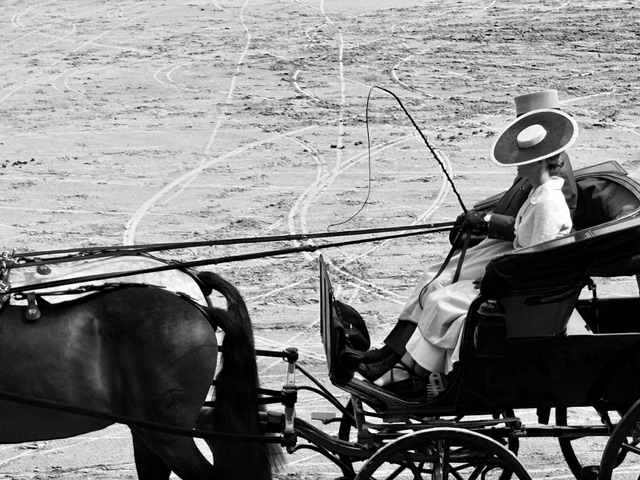
In its 46 editions, the Enganche competition has gained national and international attention. This year, 27 enganches (hitches) of different categories compete with carefully restored historical carriages and some of the most handsome specimens of Spanish and Andalusian horse breeds.
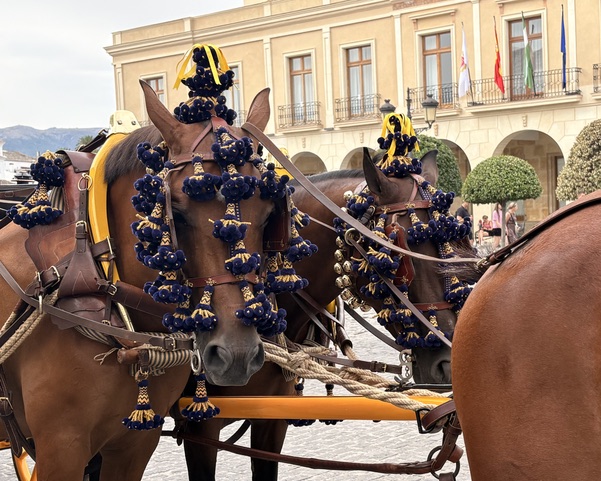
With participants from stables in Madrid, Barcelona, Galicia, Sevilla, Jerez and Málaga, every arrival is a lesson in history and traditional elegance.

A Moving Museum

While the circular stone seating gradually fills with 5000 cheering, mobile-phone-clutching and fan-waving spectators, a couple of equestrian veterans seated beneath the royal balcony introduce the names of the stables, the riders, the carriage type and comment on their performances. Usually, there are three competitors in each category, from single-horse rigs, pairs, tandems and tridems, to coaches drawn by four or even five horses.

It ought to be mentioned that this is a charity event where proceeds go to the Red Cross and other organisations. The winners are selected by the jury and announced later during the award ceremony. However, to transport half a dozen thoroughbred horses and a priceless antique carriage across the country is not something that every stable can afford. Just the sparkling harnesses must cost more than a down payment on a medium-sized villa on the Costa del Sol. Perhaps that is why one of the horsemen is introduced as a Conde (count).

The excitement in the audience escalates with each category. All the coachmen, of whom several are women, are assessed by the jury for their technique, the harmony of the horses, and the overall performance, including obligatory tasks such as trotting, backing up and steering with one hand, while ensuring that they do not become entangled with the other hitches. This is increasingly difficult, especially when three carriages with four horses (media potencia) are waiting to leave the arena, while three carriages with five horses enter at full speed, leaving the audience gasping in fear of an impending crash that never happens.

I am duly impressed by the youngest horseman this year (accompanied by an adult), who the MC reveals to be merely seven years old!

On the other hand, the most senior horsewoman must be well into her seventies. In the various carriages, there are also two dogs (hanging on for dear life), a baby and entire families dressed in period clothing, with the men in top hats and the women in straw hats pinned securely in place.
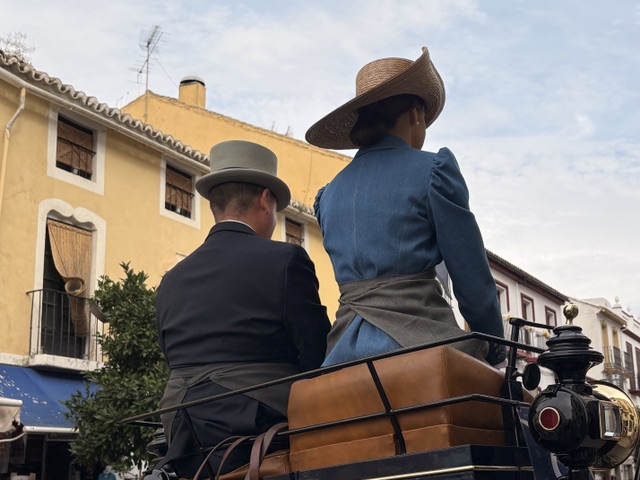
After nearly two hours comes the grand finale. All the carriages are brought back into the arena. They circle simultaneously, with the smallest hitches in the centre of the ring, gradually spreading outwards, with the largest coaches on the outside. All the while, the spectacle is accompanied by orchestral music, including Strauss’ Radetzky March, which gets thousands of audience members clapping.

Should you wish to be transported to the past, make sure to get your tickets for the next show – in September 2027. Just remember to bring your fan.
